Nils Schmitt · 3 October 2026
Material Science Behind Keel Reinforcement in Storm-Prone Regions
Keel reinforcement relies on precise material choices that balance tensile strength, corrosion resistance, and fatigue endurance in regions where storms generate repeated high-impact loads. Engineers select alloys and composites based on data from maritime testing programs that simulate years of wave action in compressed time frames.
Core Material Properties for Storm Durability
High-strength steels such as duplex stainless grades deliver yield strengths above 450 MPa while maintaining ductility that prevents brittle fracture during sudden gusts. These steels incorporate chromium and molybdenum additions that form passive oxide layers, reducing pitting rates in saltwater environments where chloride concentrations exceed 3.5 percent. Researchers at coastal laboratories measure crack propagation rates under cyclic loading to confirm that reinforced sections endure at least 10^6 cycles before reaching critical stress intensity factors.
Aluminum alloys in the 5000 and 6000 series appear in lighter vessels because their density of roughly 2.7 g/cm³ lowers overall displacement without sacrificing the section modulus required for righting moment stability. Heat treatment processes like T6 tempering increase hardness, yet designers must account for galvanic coupling when these alloys contact steel fasteners in hull assemblies.
Composite Integration Techniques
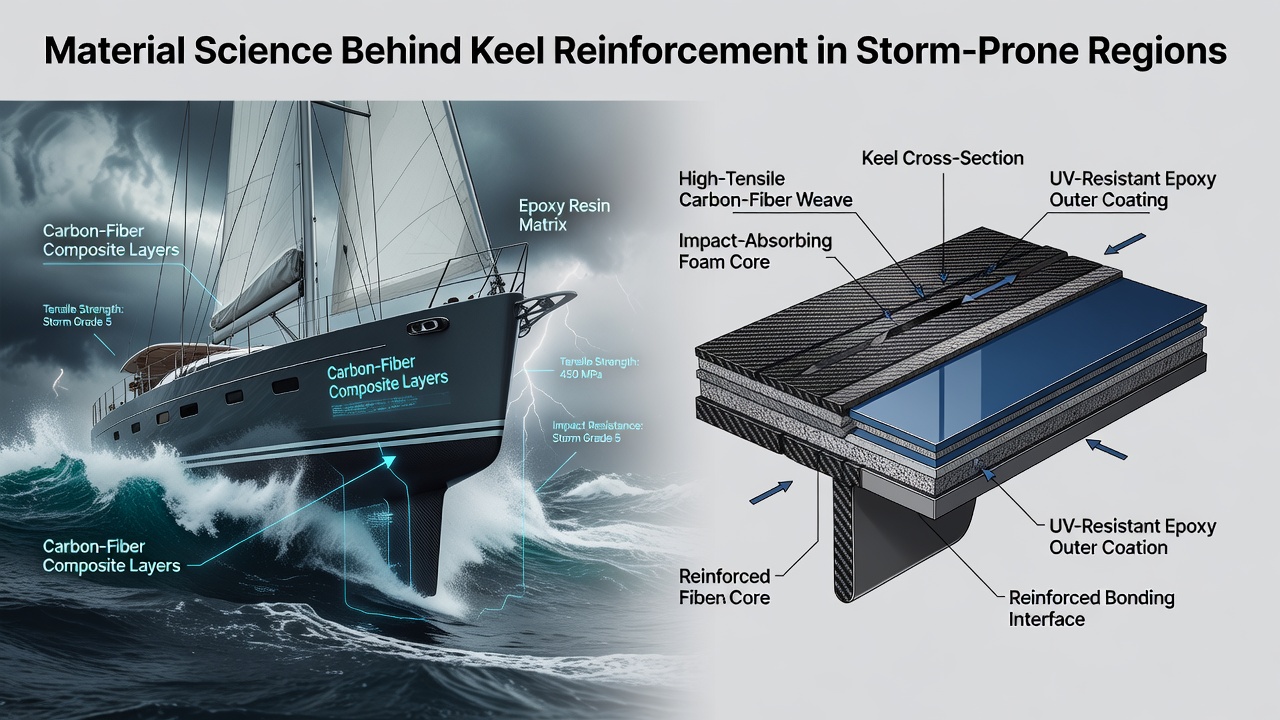
Carbon-fiber-reinforced polymers combine high modulus fibers with epoxy matrices to achieve stiffness-to-weight ratios that exceed those of metals by factors of three to five. Filament winding or vacuum-assisted resin transfer molding distributes fibers along principal stress directions identified through finite element analysis of storm-wave spectra. Interlaminar shear strength improves when z-pinning or stitching methods anchor layers against delamination that otherwise occurs after repeated flexure.
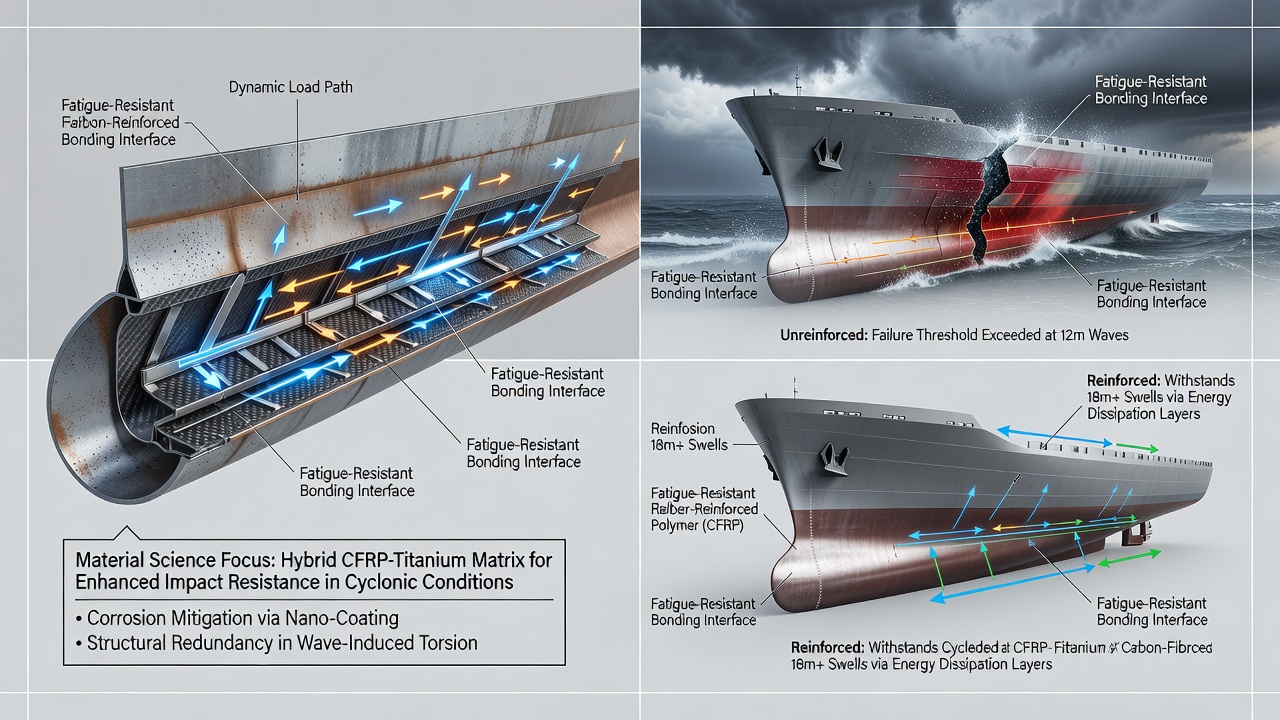
Hybrid constructions embed titanium inserts at attachment points where bolts transfer loads into the hull laminate. Titanium's passive film withstands crevice corrosion better than stainless steel in low-oxygen zones beneath the waterline, and its coefficient of thermal expansion closely matches that of carbon composites, minimizing residual stresses during temperature swings common in tropical storm tracks.
Regional Testing and Performance Data
Storm-prone basins such as the Caribbean and the North Atlantic generate significant wave heights exceeding 8 meters during named events, requiring reinforcement schedules that exceed standard classification society minima. In October 2026 the Atlantic Marine Materials Consortium released updated fatigue curves derived from full-scale keel sections subjected to irregular wave trains recorded during hurricanes. Those curves show that optimized layups extend service life by 25 percent compared with earlier monolithic steel designs.
Coatings based on fluoropolymer or ceramic-filled epoxies reduce surface roughness and limit biofouling that adds parasitic drag and localized stress concentrations. Application thicknesses between 250 and 400 micrometers maintain cathodic protection compatibility while resisting abrasion from suspended sediment in shallow coastal waters.
Manufacturing and Quality Assurance
Weld procedures for steel reinforcements follow low-hydrogen practices with preheat temperatures calibrated to plate thickness and carbon equivalent values, preventing hydrogen-induced cracking that propagates under cyclic tension. Post-weld heat treatment relieves residual stresses that otherwise accelerate fatigue crack initiation at the weld toe. Ultrasonic and phased-array inspections verify that internal defects remain below 1 millimeter in diameter before final assembly.
Quality protocols also incorporate accelerated corrosion testing in salt-spray chambers calibrated to ASTM standards, reproducing 20-year exposure in 2000-hour runs. Data collected from these tests feed probabilistic models that predict remaining life under projected storm frequency increases documented by meteorological agencies.
Conclusion
Material science advances continue to refine the balance between weight, strength, and longevity in keel systems exposed to extreme marine conditions. Ongoing collaboration between classification societies, research institutions, and vessel operators ensures that reinforcement strategies evolve alongside updated climate data and improved simulation tools. Those who monitor fleet performance records note measurable reductions in structural incidents when modern material specifications replace older baseline designs.