Parker Lang · 31 October 2026
The Hydrodynamic Calibration Routines Employed by Coastal Engineering Teams to Fine Tune Fair Keel Prototypes Under Variable Wave Spectra in Mediterranean Test Basins
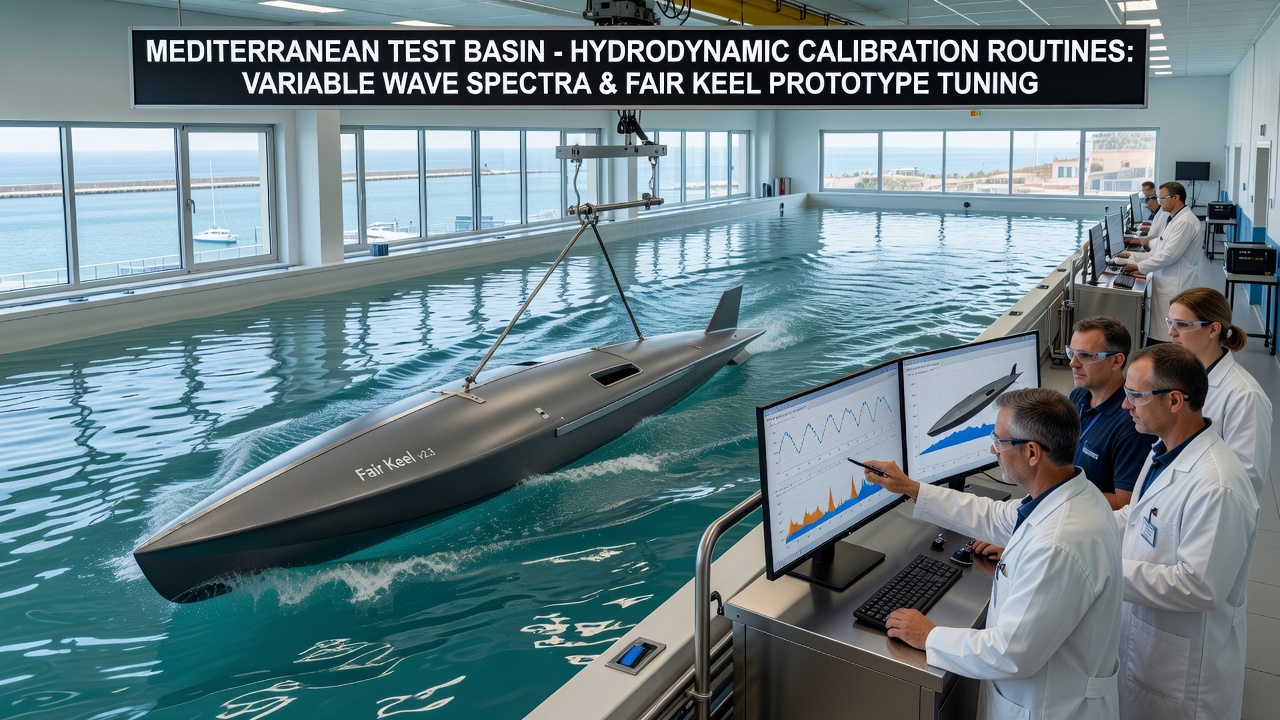
Coastal engineering teams across Mediterranean facilities rely on precise hydrodynamic calibration routines to refine Fair Keel prototypes, and these processes adapt to shifting wave conditions that range from calm swells to energetic storm patterns. Test basins in locations such as the Gulf of Genoa and the Aegean Sea replicate real-world spectra through programmable wave makers, allowing researchers to adjust prototype parameters in controlled sequences. Data from pressure sensors, velocity probes, and motion capture systems feed directly into iterative adjustments that align keel behavior with target performance metrics under JONSWAP and Pierson-Moskowitz spectra.
Core Equipment and Basin Setup
Facilities maintain large-scale tanks equipped with segmented wave generators that produce directional spectra across frequencies from 0.4 to 2.0 Hz, while current simulators introduce steady flows up to 1.5 meters per second to mimic coastal currents. Teams position Fair Keel prototypes on instrumented mounts that record six-degree-of-freedom responses, and they integrate acoustic Doppler velocimeters to map flow fields around the keel surfaces. Calibration begins with baseline still-water tests that establish neutral buoyancy and alignment tolerances before wave excitation starts.
Stepwise Calibration Procedures
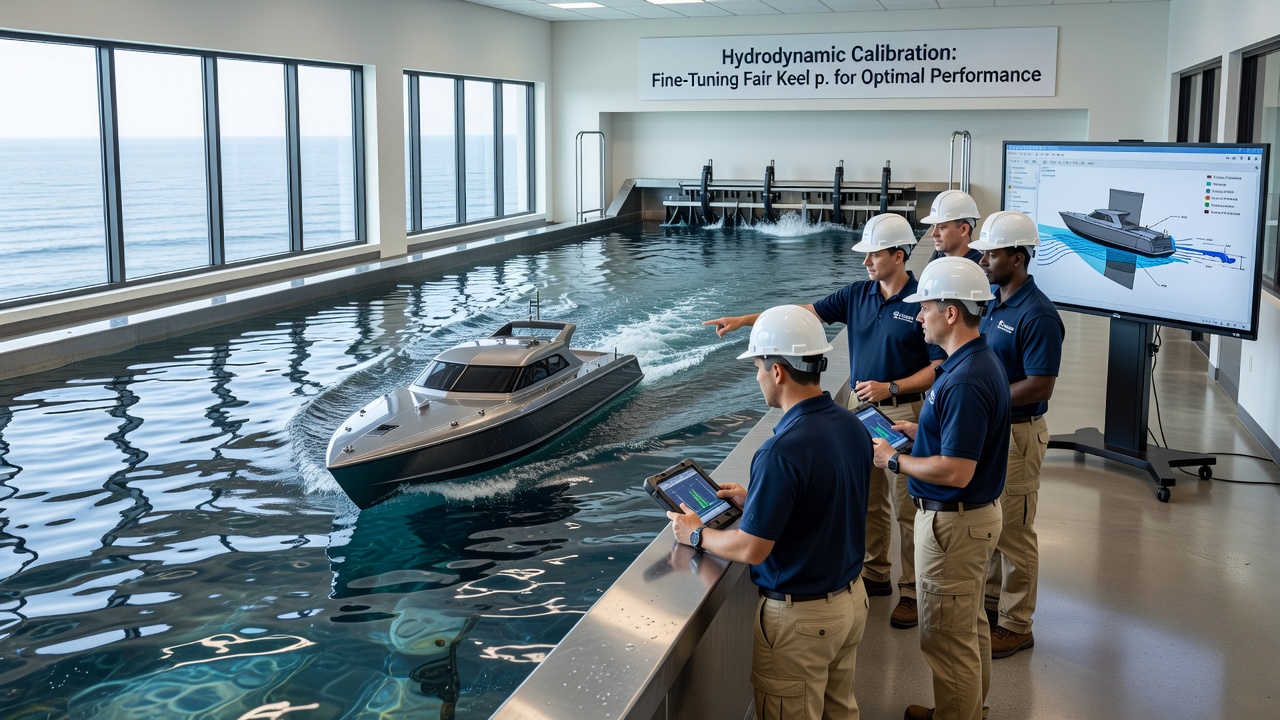
Engineers initiate each session by running monochromatic waves to isolate natural frequencies of the prototype assembly, then progress to irregular spectra that simulate Mediterranean wind-sea conditions. Software platforms compare measured heave, pitch, and roll amplitudes against numerical predictions from boundary element methods, and discrepancies trigger mechanical tweaks such as ballast redistribution or trailing-edge angle modifications. Multiple runs under the same spectrum confirm repeatability, with statistical convergence required within 5 percent variance before advancing to the next sea state.
Handling Variable Wave Spectra
Variable spectra demand sequential exposure to low-energy swell followed by high-frequency chop, and teams log spectral density functions to verify that generated waves match target distributions within 3 percent root-mean-square error. When spectra shift toward bimodal patterns common during autumn transitions, additional damping coefficients are applied through adjustable keel fins. Observers note that Mediterranean basins experience pronounced seasonal changes, so protocols incorporate October 2026 test windows to capture transitional wave climates before winter intensification.
Data Integration and Validation
Raw measurements undergo filtering to remove tank reflections, after which spectral analysis extracts significant wave height and peak period statistics for direct comparison with prototype responses. Teams cross-reference physical results against computational fluid dynamics models calibrated at institutions such as the European Maritime Safety Agency, and they refine mesh resolutions until hydrodynamic coefficients converge. External validation draws on datasets from the Australian Maritime College, where similar keel geometries underwent parallel testing in their own facilities.
Adjustments for Prototype Refinement
Fine-tuning focuses on lift-to-drag ratios and yaw stability under oblique wave approach angles, and engineers apply incremental changes to keel chord length or bulb configuration while monitoring energy dissipation rates. Real-time feedback loops allow on-the-fly corrections during a test run, and post-session reviews compile performance envelopes that guide the next design iteration. Researchers document every adjustment with photographic and laser-scanned geometry records to maintain traceability across the calibration campaign.
Long-duration tests lasting several hours expose prototypes to evolving spectra that transition from developing seas to fully developed conditions, and cumulative fatigue indicators help predict long-term structural behavior. Mediterranean-specific refraction and shoaling effects are layered into the wave generation software to increase environmental fidelity.
Conclusion
These calibration routines establish repeatable performance baselines for Fair Keel prototypes by systematically addressing the full range of Mediterranean wave conditions through integrated physical and numerical methods. Ongoing programs scheduled through October 2026 continue to expand the database of validated configurations, supporting broader application in regional coastal projects.